

Crony Capitalism
When Business Success Depends on Government Favor, Not Merit


Crony capitalism isn’t about markets—it’s about connections.
Economist Paul Rubin defines it as an economy in which business success depends on close relationships between business leaders and government officials. This can take the form of preferential permits, targeted tax breaks, government grants, or other forms of state intervention.
Economists distinguish this system from free-market capitalism. In a true market, profits arise from voluntary exchange, innovation, and efficient use of resources—not political privilege. Key mechanisms of crony capitalism include rent-seeking (lobbying for special advantages), regulatory capture, and collusion between political and business elites.
The Foundations of Free-Market Capitalism
Free-market capitalism rests on four core principles:
Sound money: A stable, predictable currency not subject to arbitrary expansion. This enables long-term planning and protects against hidden inflation.
Private property rights: Secure and enforceable ownership that allows individuals and businesses to use, trade, and invest without arbitrary interference.
Limited government: A state focused on protecting life, liberty, and property, while minimizing taxation, spending, and regulation.
Non-intervention: Free trade across borders and restraint in foreign policy, allowing voluntary exchange—not government barriers—to drive prosperity.
These principles provide a benchmark. The challenge is how far current policy has moved away from them.
Where the System Deviates
Several policy trends illustrate the gap between theory and practice:
Tariffs: Taxes on imported goods that raise prices for consumers and businesses. Recent analyses estimate costs of roughly $1,000 per U.S. household in 2025, with additional measures adding about $700. Most of the burden falls on domestic firms and consumers, and price increases have followed.
Persistent deficits: Large and ongoing deficits signal fiscal imbalance and reduce available private investment.
Rising federal debt: Congressional Budget Office projections indicate:
Deficits near $1.9 trillion annually
Federal outlays around $7.4 trillion (FY 2026)
Debt approaching 120% of GDP within the next decade
Net interest costs exceeding $1 trillion per year
Inflationary policy: Expanding the money supply faster than economic output erodes purchasing power and redistributes wealth toward early recipients of new money.
Expansive government: Regulation, subsidies, and mandates create incentives for lobbying and favoritism. Success shifts from serving customers to securing political advantages.
Taken together, these trends suggest a system increasingly shaped by government influence rather than market forces.
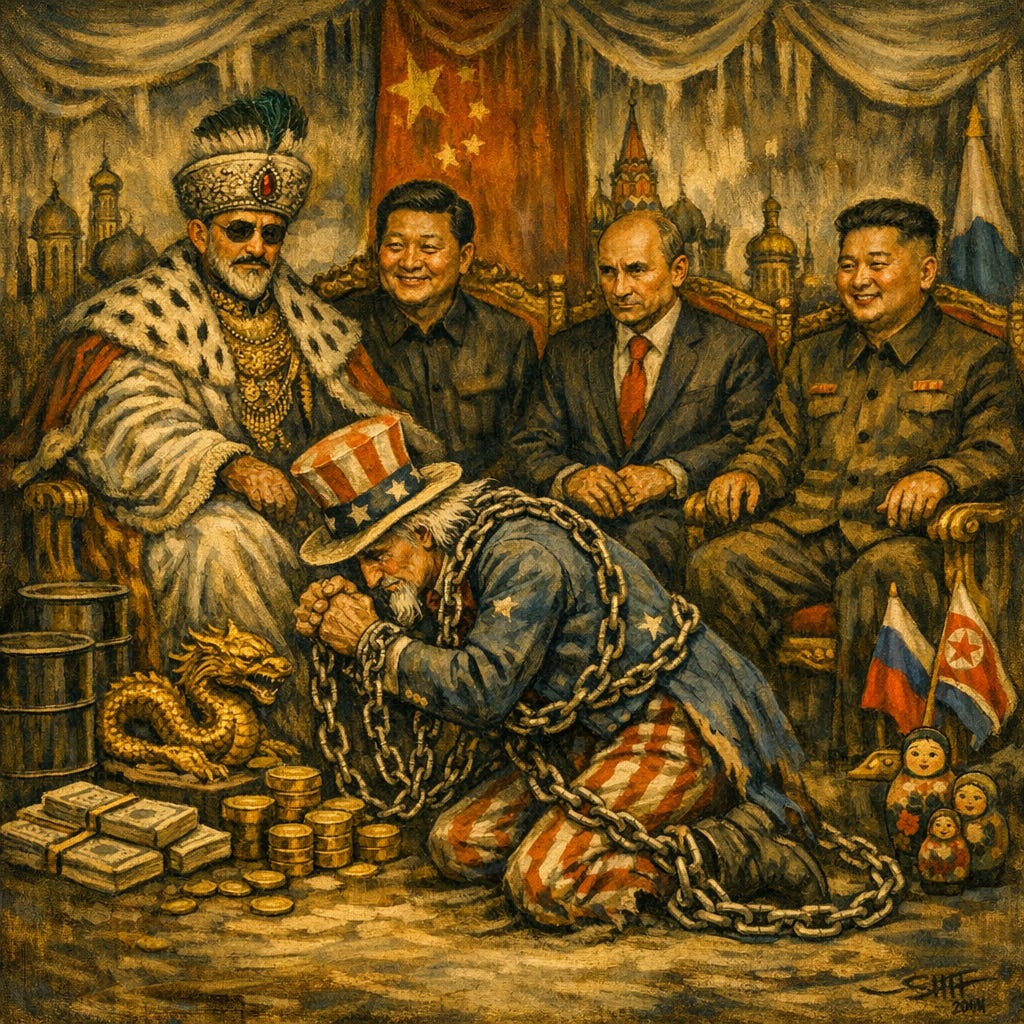
Crony Capitalism Cripples National Defense
National defense provides a clear example. Spending reached about $919 billion in FY 2025, with requests exceeding $1 trillion for FY 2026 and rising further in future proposals.
These budgets fund major contracts for weapons systems, modernization, and global operations. However, when firms compete based on political access rather than performance, inefficiencies can emerge. Cost overruns, delays, and excess spending may follow, potentially diverting resources from actual readiness.
A more restrained foreign policy—focused on defense of the homeland rather than extended global commitments—would reduce both spending pressures and opportunities for rent-seeking. While increased budgets are often justified as strengthening security, higher spending alone does not necessarily produce more effective outcomes.
We can only be free and self-ruled when we can defend our borders and citizens.
Broader Implications
As government expands in size and scope, opportunities for cronyism grow alongside it.
Key indicators include:
Federal outlays nearing $7.4 trillion
Annual deficits around $1.9 trillion
Debt levels trending toward 120% of GDP
Defense spending exceeding $1 trillion
Each additional layer of tariffs, subsidies, contracts, or regulation increases the incentive for businesses to seek political advantage. Over time, this can lead to:
Higher consumer costs
Distorted resource allocation
Persistent inflationary pressures
Reduced economic dynamism
Questions about the effectiveness of large public expenditures
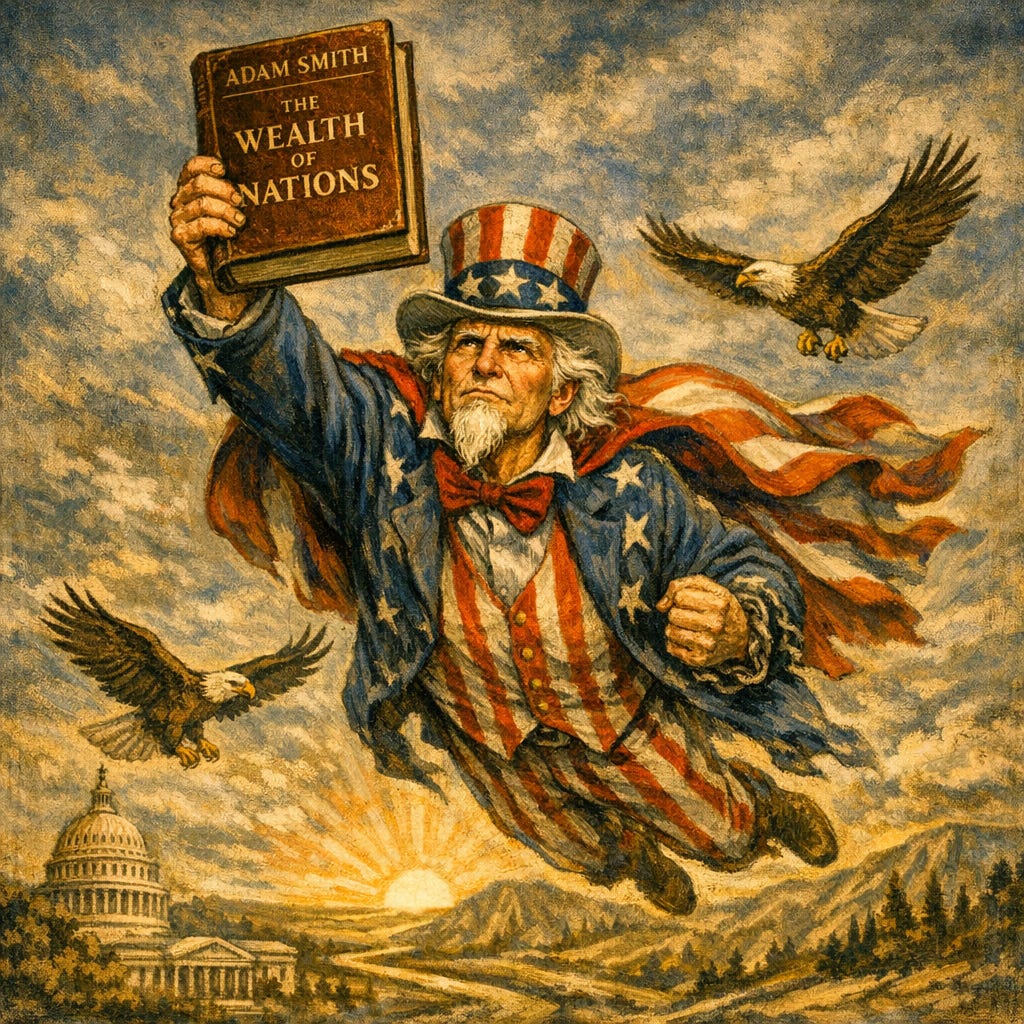
Potential Remedies
One proposed response is to reduce the scope of government involvement in economic activity. This approach emphasizes:
Maintaining a stable and predictable currency
Reducing spending across major budget categories
Limiting regulatory complexity
Eliminating targeted subsidies and special preferences
Returning to a more restrained foreign policy
The underlying idea is that fewer intervention points reduce opportunities for favoritism and restore incentives for value creation.
Conclusion
America’s economic strength and long-term stability depend on institutions that reward innovation, productivity, and voluntary exchange. When success increasingly depends on political connections, those foundations weaken.
Current fiscal and policy trends—including large deficits, expanding government programs, and rising public debt—suggest a growing gap between free-market principles and real-world practice.
The central question is not whether government plays a role, but how large that role should be—and whom it ultimately serves. Systems that prioritize competition and transparency tend to reward value creation. Systems that prioritize access and influence risk drifting toward cronyism.
The direction chosen has implications not only for economic performance, but also for national priorities, long-term growth, and future generations.